
In the global narrative of addressing plastic pollution and achieving “dual-carbon” goals, chemical recycling centered on waste plastic pyrolysis technology has emerged as a strategic and rapidly growing industry. It is projected that by 2030, the global demand for chemically recycled products will exceed 10 million tons, demonstrating immense market potential.
I. The Cornerstone of the Current Industrial Model: The “Mass Balance” Approach
During the initial stages of the chemical recycling industry for waste plastics, a model known as “mass balance” has become the widely adopted operational framework. This approach essentially serves as a bridge connecting the emerging circular industry with the vast traditional petrochemical system, representing a pragmatic choice under current technological, capacity, and infrastructure constraints.
At its core, the “mass balance” model involves feeding intermediate products from chemical recycling—primarily pyrolysis oil—into existing petroleum refining facilities, where they are processed alongside conventional petroleum-based feedstocks (e.g., naphtha). Subsequently, based on the mass of recycled feedstock introduced, a portion of the output petrochemical products (such as polyethylene or polypropylene) is certified as “recycled products” through a scientifically defined calculation and tracking protocol.
While the “mass balance” model relies heavily on existing petrochemical infrastructure, it imposes stringent quality standards on pyrolysis oil as feedstock, demanding advanced pretreatment and purification technologies. Since the recycled feedstock does not physically correspond one-to-one with the final certified products, this model may face challenges as production capacity expands and consumers or brand owners increasingly demand greater transparency and traceability.
II. Technological Foundation and Industrial Enablement: The Outstanding Contributions of Niutech
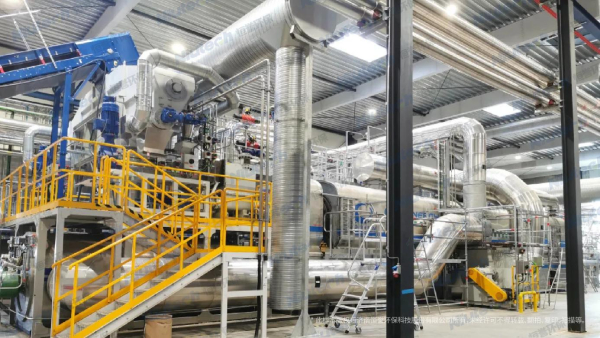
Underpinning the “mass balance” model, the successful operation of chemical recycling for waste plastics depends on a common prerequisite: the efficient, stable, and large-scale conversion of waste plastics into high-quality intermediate or final products. In this critical area, Niutech, with nearly four decades of dedicated research, provides a solid technological foundation. The company has developed highly efficient and mature plastic pyrolysis equipment that enables continuous, safe, environmentally compliant, and pollution-free operation throughout the pyrolysis process. Through its internationally successful projects, Niutech has set a benchmark for the commercial validation of the entire industry.
The transition of waste plastic pyrolysis from laboratory to industrialization has faced significant technical barriers, particularly in achieving large-scale, industrial continuous, and long-term stable operation. Many global pyrolysis projects operate below their designed capacity, primarily due to unresolved industry-wide challenges such as reactor coking, dynamic sealing difficulties during feeding/discharge, and product polymerization.
Niutech’s technological capabilities extend beyond the laboratory or domestic markets, having been rigorously tested in international high-end projects.
A landmark case involves an internationally renowned group that, after extensive global screening and comparison, selected Niutech’s “New Generation • Large-Scale Industrial Continuous Intelligent Waste Plastic Pyrolysis Technology and Integrated Equipment” to build a high-end chemical recycling plant for waste plastics in Vietnam. This project converts industrial plastic waste into high-quality pyrolysis oil, which is directly used in the client’s own chemical plant for further processing, successfully achieving a complete closed loop of “waste plastic-to-new plastic” chemical recycling. The project has been successfully commissioned and has operated efficiently and continuously for several months, earning high praise from the client, with plans for expansion and replication underway. This project vividly demonstrates a closed-loop model akin to “N+1,” emphasizing upstream-downstream collaboration.
Additionally, Niutech’s technology has long been recognized by international chemical giants. Its equipment was deployed in a Danish chemical recycling project for waste plastics, which received investment from BASF. Currently, a large-scale waste plastic pyrolysis resource recovery project in the UK, utilizing Niutech’s technology, is also progressing smoothly. Niutech’s technology and equipment have obtained seven authoritative international certifications, including EU CE, German TÜV, ATEX explosion-proof, and ISCC International Sustainability and Carbon Certification, and have been exported to dozens of countries and regions worldwide. These achievements fully demonstrate that China’s high-end environmental equipment has reached a level of technological sophistication, reliability, and environmental standards that enable it to compete with international giants, providing core equipment support for global chemical recycling projects.