
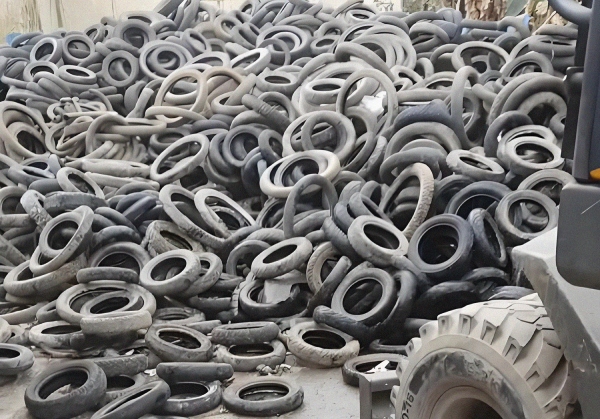
Globally, the “black pollution” caused by scrap tires has become a pressing environmental challenge. As the circular economy and “dual-carbon” goals advance, industrial continuous pyrolysis technology—capable of fully converting scrap tires into high-value resources—is rapidly evolving from a cutting-edge innovation into a scalable, global green industry solution. As a global leader in this field, Jinan Niutech Environmental Technology Co., Ltd., with nearly four decades of technical expertise and successful worldwide industrial applications, exemplifies the immense advantages and broad prospects of pyrolysis for scrap tire treatment.
I. Dual Environmental and Resource Benefits: Core Advantages of Continuous Tire Pyrolysis
Pyrolysis is regarded as the “ultimate method” and a critical pathway for scrap tire recycling due to its comprehensive environmental, resource, and economic advantages. It transforms scrap tire recycling equipment into a complete industrial waste-to-energy conversion system.
– Complete Achievement of “Harmlessness, Resource Recovery, and Volume Reduction”: Unlike simple incineration or landfilling, pyrolysis involves incomplete thermal degradation of tires in oxygen-deficient or oxygen-free environments, effectively preventing the generation of harmful gases like dioxins and eliminating secondary pollution at its source. This technology converts nearly 100% of a scrap tire into valuable secondary raw materials, including pyrolysis oil, recovered carbon black, steel wires, and combustible gas, achieving “tire-to-oil” conversion and turning waste into treasure.
– Significant Economic Value Creation: Rubber pyrolysis products have clear market applications and substantial economic benefits. Pyrolysis oil can serve as industrial boiler fuel or be further refined; carbon black is a crucial raw material for rubber, plastics, inks, and other industries, with high-quality carbon black potentially exceeding the value of pyrolysis oil; steel wires can be directly recycled for smelting; and non-condensable combustible gas provides energy for the pyrolysis process itself, enabling energy self-sufficiency and driving sustainable industry development.
– Supporting Energy and Resource Security: Carbon black production heavily relies on petroleum resources. Pyrolysis recovers carbon black from scrap tires, and estimates suggest that producing 1 ton of carbon black requires 1.5–2 tons of petroleum. Thus, promoting this technology conserves precious petroleum resources and alleviates energy pressures. Additionally, it converts waste into renewable resources, aligning with the core needs of “zero-waste cities” and green, low-carbon development.
II. Technological Breakthroughs and Industrial Upgrades: Niutech Solves Global Industry Challenges
Although pyrolysis principles have long been understood, achieving stable, continuous industrial operation was once a globally recognized technical bottleneck. Many projects struggled with issues like equipment coking, sealing difficulties during feeding/discharge, and product polymerization, resulting in actual capacity far below design levels. Niutech’s core contribution lies in overcoming these challenges through nearly 40 years of sustained R&D, advancing the industry from intermittent, crude “primitive oil refining” to intelligent, continuous modern industrial processes.
Niutech’s self-developed “Key Technology and Equipment for Pyrolysis Resource Recovery of Organic Solid Waste” integrates core technologies such as coking-free operation, gas-tight sealing, and anti-polymerization. Its equipment achieves a pyrolysis rate exceeding 99%, ensuring high efficiency and environmental compliance. This technology has been honored with the National Science and Technology Progress Award and listed by multiple Chinese ministries as a key encouraged environmental technology.
III. Global Industrial Applications: “Chinese Intelligent Manufacturing” Solutions Gain Worldwide Trust
Niutech’s success stems not only from technological breakthroughs but also from its technology’s rigorous validation and widespread recognition in global markets, achieving a leap from technology export to business model export.
– Stringent International Certifications: Niutech’s technology and integrated equipment have obtained rigorous international certifications, including EU CE, German TÜV, ATEX explosion-proof, and ISCC (International Sustainability and Carbon Certification). This signifies that its products meet or exceed developed-country standards in safety, environmental compliance, quality, and carbon reduction, making Niutech one of the few domestic suppliers capable of overcoming overseas technical barriers.
– Global Project Deployment with Replicable Solutions: Niutech’s equipment has been successfully exported to dozens of countries and regions, including Germany, the UK, Brazil, Hungary, and South Korea. Particularly in the European market, its solutions have gained deep acceptance.
Niutech’s global practices compellingly demonstrate that through persistent technological innovation, overcoming challenges in continuous and intelligent production, and strictly adhering to international standards, Chinese environmental technology and equipment can achieve world-leading standards and provide mature, reliable “Chinese solutions” for the global circular economy and sustainable development.