
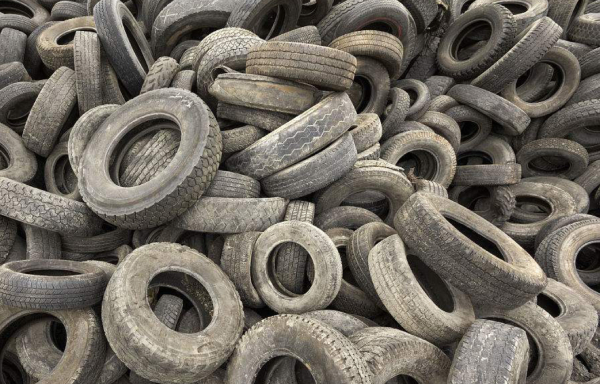
Every year, hundreds of millions of waste tires are discarded globally due to wear and tear. Resistant to natural degradation, long-term accumulation of these tires not only occupies vast land areas but also poses fire hazards and environmental contamination risks, earning them the label of “black pollution.” Yet, from a circular economy perspective, these tires are not waste but rather “urban mines” rich in rubber, carbon black, and hydrocarbon resources. Through advanced pyrolysis technology, they can be systematically transformed into high-value products such as recovered carbon black and fuel oil, achieving a qualitative shift from “black waste” to “black gold.” Technology-driven companies like Niutech, with their internationally leading green recycling solutions, are turning waste tire processing into a large-scale, high-efficiency industrial practice.
I. Core Technology: The Resource Regeneration of Rubber Pyrolysis
At the heart of waste tire pyrolysis lies a precise “molecular-level dismantling and reconstruction” process, where high-molecular polymers in tires undergo chain scission and recombination in medium-to-high temperature, oxygen-free or oxygen-deficient environments. This results in the production of pyrolysis oil, recovered carbon black, steel wires, and combustible gas, achieving nearly 100% resource recovery.
The success of this process heavily depends on technological maturity and stability. The industry has long faced three major global challenges: “system coking, dynamic sealing difficulties during feeding/discharge, and product polymerization,” which have hindered the continuous and stable operation of many systems. Through nearly four decades of research and development, Niutech’s core technology integrates multiple patented innovations such as “coking-free,” “gas-tight sealing,” and “anti-polymerization,” successfully overcoming these bottlenecks and achieving an efficient, harmless treatment with a pyrolysis rate exceeding 99%. It is precisely this technical reliability that enabled Niutech’s “Key Technology and Equipment for Pyrolysis Resource Recovery of Organic Solid Waste” to be included in the 2025 “Catalog of Advanced Applicable Process Technologies and Equipment for National Industrial Resource Comprehensive Utilization” issued by China’s Ministry of Industry and Information Technology—a testament to its national-level authoritative recognition.
II. System Process: Full-Chain Intelligent Resource Recovery
From tire recycling operations to the sales and high-value applications of pyrolysis products, modern advanced pyrolysis technology has evolved into a complete industrial chain characterized by intelligence, continuity, and high-value output.
1. Intelligent Preprocessing and Precise Feeding: Waste tires first undergo preprocessing steps such as shredding and steel wire separation to produce uniformly sized fragments. Niutech’s new-generation intelligent production line establishes a “full-process intelligent control” system, laying the foundation for efficient and uniform pyrolysis reactions.
2. Continuous Pyrolysis and Product Separation: Preprocessed tires are fed into the continuous pyrolysis system, where cracking reactions occur in a sealed environment. The resulting pyrolysis oil and gas are separated via a rapid condensation system into liquid pyrolysis oil, while non-condensable clean combustible gas is recycled to power the system, achieving energy self-sufficiency. The remaining solid residues are processed into recovered carbon black, and steel wires from the tires are simultaneously reclaimed.
3. Product Refinement and High-Value Applications: Primary products undergo deep processing to enhance their value. Pyrolysis oil can be further refined for use as industrial fuel or chemical feedstock. Recovered carbon black, through modification technologies, can be reused in rubber products, plastics, or as fillers, partially replacing higher-priced, higher-carbon-footprint virgin carbon black.
III. Dual Economic and Environmental Value: Quantifying the Benefits of “Waste-to-Wealth”
Pyrolysis technology creates a clear economic closed loop and delivers significant environmental benefits. Beyond the direct economic output of pyrolysis products, its environmental impact is even more profound. This process prevents pollution caused by landfilling or improper disposal of waste tires while significantly reducing crude oil consumption and carbon dioxide emissions through the substitution of recycled materials for virgin resources, directly contributing to “dual-carbon” goals.
Niutech’s equipment and products have obtained certifications including EU CE, German TÜV, ATEX explosion-proof, and the authoritative ISCC International Sustainability and Carbon Certification. This means that products like pyrolysis oil and recovered carbon black have gained a “passport” to enter global high-end green energy markets. The technology has been exported to dozens of countries, including Germany, Denmark, Brazil, and Thailand.