
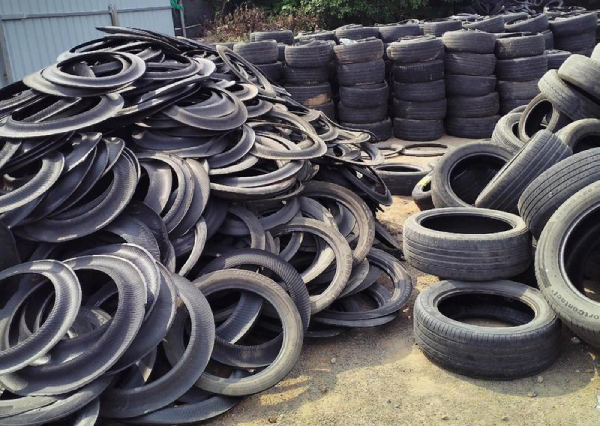
In the grand context of the global circular economy and “dual-carbon” goals, the “black pollution” caused by scrap tires presents a worldwide challenge. Traditional disposal methods, such as landfilling and incineration, not only waste resources but also pose serious environmental and health risks. Confronted with this challenge, industrial continuous pyrolysis technology has emerged as the solution, recognized by industry experts as the “ultimate method for scrap tire recycling.” It not only achieves the recycling and harmless treatment of scrap tires but also establishes a high-value resource recovery pathway that transforms tires into oil.
I. Core Advantages of Continuous Pyrolysis Technology: A Paradigm Shift from “Treatment” to “Creation”
Continuous pyrolysis technology is regarded as a critical direction for industry development because it represents a qualitative leap over traditional batch processing or outdated “primitive oil refining” in terms of environmental performance, efficiency, resource recovery, and value creation.
At its core, continuous pyrolysis technology decomposes the high-molecular polymers in scrap tires within a sealed, oxygen-free or oxygen-deficient environment using tire pyrolysis equipment with precise temperature control. Its greatest advantage lies in fully utilizing scrap tires, producing pyrolysis oil, carbon black, steel wires, and other outputs through pyrolysis. The entire process occurs within a fully sealed, automated production line, achieving “zero pollution, zero residue, zero emissions, and full utilization,” thereby eliminating at the source the environmental damage caused by emissions from primitive oil refining workshops.
“Stable continuous operation” is a key criterion for assessing the industrial viability of pyrolysis technology and a defining feature that distinguishes it from outdated methods. Hindered by technical bottlenecks such as “equipment coking, sealing difficulties during feeding/discharge, and product polymerization,” many systems fail to meet the demands of industrial continuous operation, often resulting in actual output falling below design capacity. Advanced continuous technology, through intelligent control systems, enables fully automated control from feeding and pyrolysis to product collection, ensuring stable, efficient, and safe production. Factories utilizing such technology, such as those equipped with Niutech’s self-developed scrap tire pyrolysis systems, have achieved a qualitative leap in tire pyrolysis.
Continuous pyrolysis not only addresses pollution but also creates substantial economic value. Its outputs have clear market applications: tire pyrolysis oil can serve as industrial fuel; recovered carbon black, after deep processing, can be used in rubber, plastics, and other industries; steel wires are recycled for smelting; and non-condensable gas is cycled back to power the system. Estimates suggest that if the millions of tons of scrap tires generated annually were processed under standardized conditions, it could form an industrial chain with an annual output value exceeding tens of billions of yuan.
II. Technological Breakthrough: Niutech Solves the Global Challenge of Continuous Operation
Translating the theoretical advantages of continuous pyrolysis into stable and reliable industrial practice requires overcoming a series of engineering challenges. Jinan Niutech Environmental Technology Co., Ltd., with nearly four decades of dedicated research and development, has become a global leader in solving these challenges.
Niutech’s self-developed “Key Technology and Equipment for Pyrolysis Resource Recovery of Scrap Tires” employs core patented technologies such as coking-free operation, gas-tight sealing, and anti-polymerization, successfully addressing industry-wide bottlenecks.
The technological sophistication of Niutech’s systems is reflected in the “smart brain” installed in its production lines—an advanced intelligent control system capable of real-time monitoring and adjustment of nearly 20,000 technical parameters. This ensures that the equipment maintains efficient, stable, and long-term continuous operation at a 10,000-ton processing scale. It is precisely this ability to solve challenges related to “continuity, stability, and scalability” in production that has enabled Niutech’s technology and integrated equipment to obtain seven authoritative international certifications, including EU CE, German TÜV, and ISCC, allowing its products to be exported to dozens of countries and regions worldwide, including Germany, Brazil, and South Korea.
The advantages of continuous pyrolysis technology in the comprehensive utilization of scrap tires are comprehensive and revolutionary. Through stable industrial continuous operation, it achieves complete environmental compliance in the treatment process and high-value outputs, transforming environmental burdens into economic assets.
Niutech’s industrial practices clearly demonstrate that through persistent technological innovation, overcoming the core bottleneck of “continuous operation,” and building an integrated “equipment + operations” model, Chinese environmental technology enterprises can provide world-leading solutions.