
Due to their complex composition—including natural and synthetic rubber, carbon black, and various chemical additives—scrap tires are extremely difficult to decompose in nature, taking over a hundred years to break down while continuously releasing microplastics and harmful chemicals that pose a long-term threat to the ecological environment. Facing this challenge, major global economies have elevated the management of scrap tires to a strategic priority.
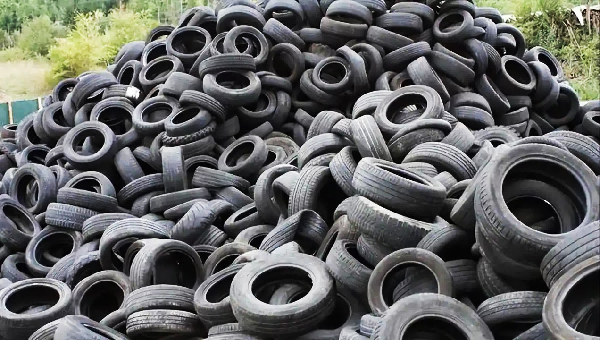
The conversion of scrap tires into fuel, known as Tire-Derived Fuel (TDF), saw the United States convert 58% of its scrap tires into fuel as early as 2020, replacing traditional fossil fuels. The European Union has mandated that member states increase their scrap tire recycling rate to 85% by 2025 and is promoting cross-regional TDF circulation through unified standards. Japan has already achieved a TDF utilization rate of 68%, primarily in power plants and cement kilns. As tire pollution intensifies and environmental requirements become increasingly stringent, the global TDF process is accelerating.
Among the four major methods of scrap tire treatment—tire retreading, reclaimed rubber production, rubber powder processing, and pyrolysis—pyrolysis technology is widely recognized as the ultimate method for scrap tire recycling and an effective approach to achieving harmless treatment and resource recovery. This technology, operating under oxygen-free or oxygen-deficient conditions, uses high temperatures to decompose the high-molecular polymers in scrap tires, ultimately producing high-value-added products such as pyrolysis oil, carbon black, steel wire, and combustible gas.
Compared with traditional treatment methods, pyrolysis technology offers significant environmental advantages. It is estimated that processing 10,000 tons of scrap tires via pyrolysis can reduce carbon dioxide emissions by approximately 11,000 tons. This carbon reduction benefit is particularly valuable in the context of global “dual-carbon” goals. The most important product—tire pyrolysis oil—has a wide range of applications, serving as industrial fuel or being further refined into gasoline and diesel. The recovered carbon black, after deep processing, can replace a portion of commercial carbon black in rubber product manufacturing. The steel wire can be directly recycled for smelting, while the combustible gas provides energy for the system itself—this nearly 100% resource utilization rate truly achieves full material recovery.
In this technological battle, the Chinese enterprise Jinan Niutech Environmental Technology Co., Ltd. has become a global leader in the pyrolysis field through nearly 40 years of dedicated R&D. Niutech’s self-developed “Large-Scale Continuous Intelligent Tire Pyrolysis System” has successfully solved long-standing industry pain points, enabling continuous pyrolysis and stable operation. This technology has been honored with the National Science and Technology Progress Award and has established the company as a standard-setter and technology leader in China’s pyrolysis sector.
Niutech’s technology and integrated equipment have obtained seven major international certifications, including EU CE, German TÜV, ATEX explosion-proof, and ISCC International Sustainability and Carbon Certification, making it the first domestic manufacturer of high-end intelligent continuous pyrolysis equipment capable of simultaneously meeting this comprehensive set of standards. Its advanced intelligent control system can monitor and adjust nearly 20,000 technical parameters in real time, ensuring long-term, stable, and continuous operation at a processing scale of tens of thousands of tons.
Niutech’s technological advantages have been fully validated through global industrial practices. In Brazil, its scrap tire pyrolysis project primarily processes passenger car and truck tires, with an annual capacity of 30,000 tons. The recovered carbon black, after processing, is used in industries such as ink and pigments, while the pyrolysis oil is used as fuel. This project has been operating stably for over 10 years, fully demonstrating the reliability of the technology and the sustainability of the business model.
In Hungary, a scrap tire pyrolysis project has been recognized as an EU demonstration project. The project uses pyrolysis to process collected scrap tires, producing carbon black and pyrolysis oil, with the pyrolysis oil achieving TDF utilization. This project provides a replicable and scalable model for EU member states to promote the resource utilization of scrap tires.